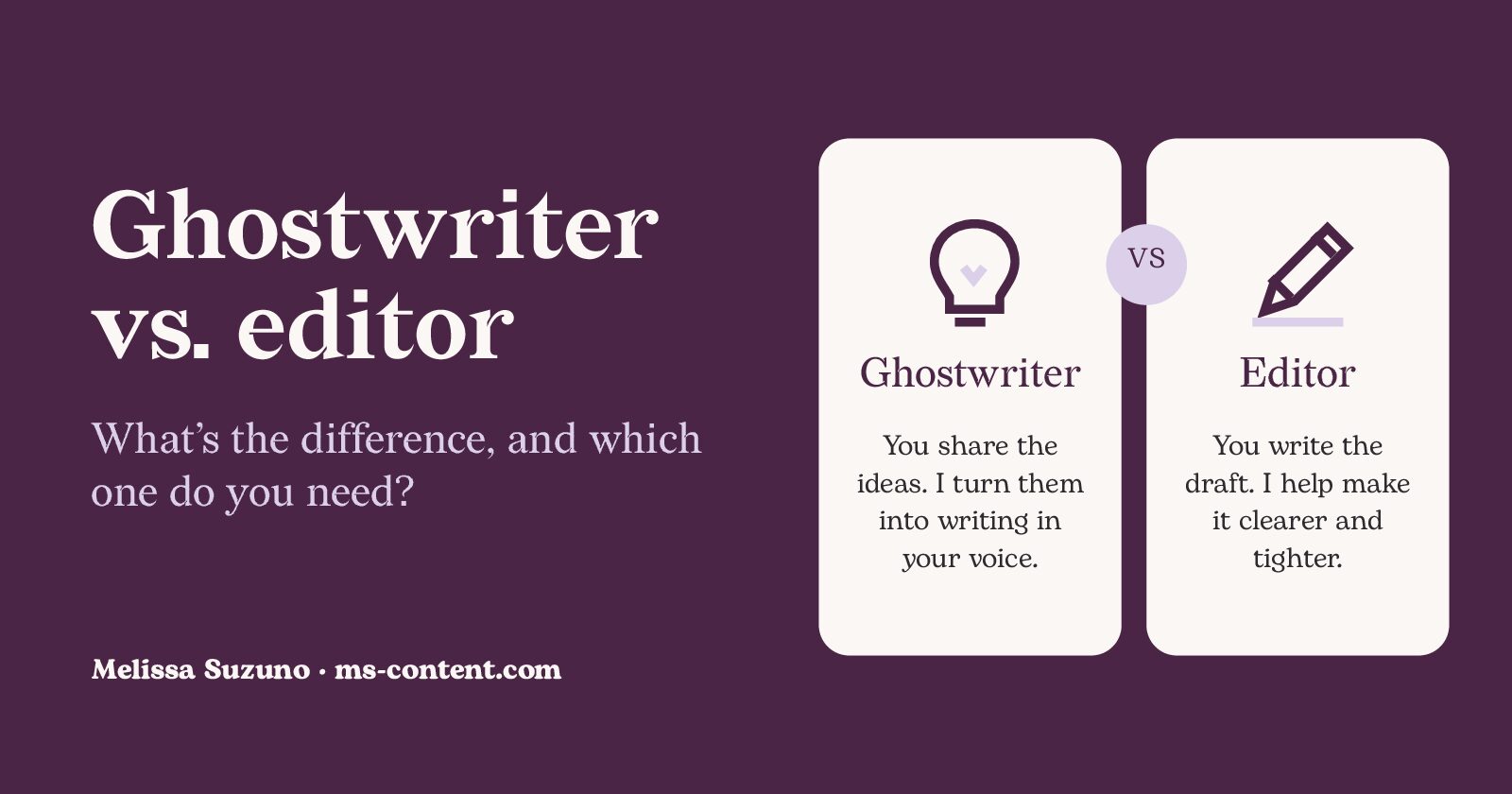
The short answer: An editor works with writing you’ve already drafted, making it clearer, tighter, and more consistent while keeping it in your voice. A ghostwriter does the drafting for you, turning your ideas, notes, or conversations into finished writing that’s published under your name. If you enjoy putting words on the page, you probably want an editor. If you love the ideas but dread the drafting, you probably want a ghostwriter.
I get some version of this question a lot, usually from people who are just getting started with a content project (a blog, a newsletter, a book) and aren’t sure what kind of help to ask for. It’s a great question, and I’ll admit I’m a little biased, because I do both. So let’s break it down.
Ghostwriter vs. editor at a glance
| Editor | Ghostwriter | |
|---|---|---|
| Who writes the first draft? | You | The ghostwriter, based on your ideas |
| What you bring | A draft (rough or nearly done) | Ideas, outlines, notes, voice memos, or time for a conversation |
| What they do | Improve structure, clarity, flow, word choice, and accuracy | Research, outline, draft, and revise in your voice |
| Your time commitment | Higher: you do the writing and review the edits | Lower: you share ideas up front and review drafts |
| Whose name is on it? | Yours | Yours |
| Best for | People who like writing but want it to be clearer or more effective | People with plenty of ideas and not enough time (or patience) for drafting |
| Common formats | Blog posts, email courses, books, articles | Blog posts, LinkedIn posts, newsletters, website copy, books |
What does an editor do?
An editor’s job is to help you clearly convey your ideas. Depending on where your draft is, that might mean offering big-picture feedback on structure and flow, sentence-level line editing, or a final proofread that involves hunting down every last typo (I take that part VERY seriously).
The key thing is that the words start with you. When I edited Teresa Torres’s book Continuous Discovery Habits, Teresa was the writer. My job was to help make sure every chapter was clear and that her ideas landed with readers. When the team at 1106 Design later evaluated the manuscript, they didn’t find a single spelling error in the first 75 pages—a first in the evaluator’s 8+ years of doing this type of review. (Call me a nerd, but this is still one of my proudest professional accomplishments to date!)
Editing isn’t only for books, though. Executive coach Kate Leto would sometimes send me her own drafts of blog posts and articles, and I’d polish them so they felt more cohesive. As Kate put it, “Melissa could always help me maintain a consistent tone of voice.” You can read more about my work with Kate here.
What does a ghostwriter do?
A ghostwriter takes your ideas and turns them into finished writing that sounds like you. You’re still the expert, and the thinking is still yours. You’re just handing off the part where you spend countless hours staring at a blank page.
This is how I’ve worked with transformation coach Martina Hodges-Schell since January 2021. Martina brings ideas (and sometimes a rough outline) to our monthly conversations, we decide on the structure together, and I turn them into polished pieces.
She’d been trying to create a regular writing practice for years but kept putting it off. Now she has a predictable publishing schedule and a growing library of content she uses to answer client questions. In her words: “I’ve gone from content creation being a chore that I never managed to make stick to the polar opposite.” Here’s the full story of my work with Martina.
Why the difference matters right now
Here’s the thing: Almost everyone has access to a robot writing assistant these days. According to Orbit Media’s 2026 blogging survey of 1,042 content marketers, 92.4% now use AI for blogging. But only 13.9% report “strong results,” an all-time low for the survey, down from 26% in 2022.
So more content is getting made, but less of it is working. Orbit Media’s research found that marketers with “a more formal approach with human oversight are much more likely to drive performance.” In fact, their research shows that marketing teams that use a formal editing process are 1.6 times more likely to report strong results than those that don’t. That matches what I see. A lot of writing out there sounds the same because AI tools tend to reach for the same words and structures over and over and over and… you get the picture.
And quality matters to the people you most want to reach. In the 2025 Edelman-LinkedIn B2B Thought Leadership Impact Report, a survey of nearly 2,000 management-level professionals, 95% of buyers said high-quality thought leadership does a better job than traditional marketing or product information at showing what a supplier can do. And 79% said they’re more likely to champion a vendor during the RFP process if it consistently publishes quality thought leadership.
Whether you work with an editor or a ghostwriter, the goal is the same: content that sounds like a real person with real expertise (because it is), published consistently enough that people notice.
So which one do you need?
I’ll answer this question with a question back to you: Would you rather do more of the writing yourself, or would you rather come up with the ideas and hand off the writing to someone else?
- You probably want an editor if you like the work of putting words on the page and you want help with structure, clarity, voice, consistency, or storytelling.
- You probably want a ghostwriter if you love coming up with ideas but find the process of getting them onto the page tedious and unrewarding.
- You might want a bit of both if your energy changes from project to project. That’s pretty common!
That last option is how I work with product leadership coach Petra Wille. Some weeks I turn her rough ideas into finished blog posts, and other weeks I edit her drafts because there’s almost always one more improvement to make. As Petra described it, “Now I only have to spend the initial hour or two on the concept and Melissa takes care of the rest.” You can read Petra’s take on our work together here.
Still not sure?
That’s completely okay. Every collaboration begins with a conversation, and figuring out the right kind of support for you is part of our first chat. If you’re a coach, consultant, or SaaS marketing lead with ideas you want to get out into the world, or you know someone who is, let’s talk!
And if you’ve worked with an editor or ghostwriter before, I’d love to hear about it. What made you choose one over the other?